

Beyond the Singularity: Homo Techno and the Thousandfold Leap
AGI is not the endpoint. It is the threshold. Beyond it lies Homo techno, longevity, and a redefinition of what it means to be human.

From Exponential Curves to Evolutionary Thresholds
Few thinkers have shaped the modern conversation about the future of intelligence as profoundly as Ray Kurzweil. An inventor, computer scientist, and long-range futurist, Kurzweil has spent more than four decades studying the deep patterns behind technological change. He is widely recognised for his work in optical character recognition, speech synthesis, and human–computer interaction, as well as for a body of writing that has become foundational to contemporary futurism.
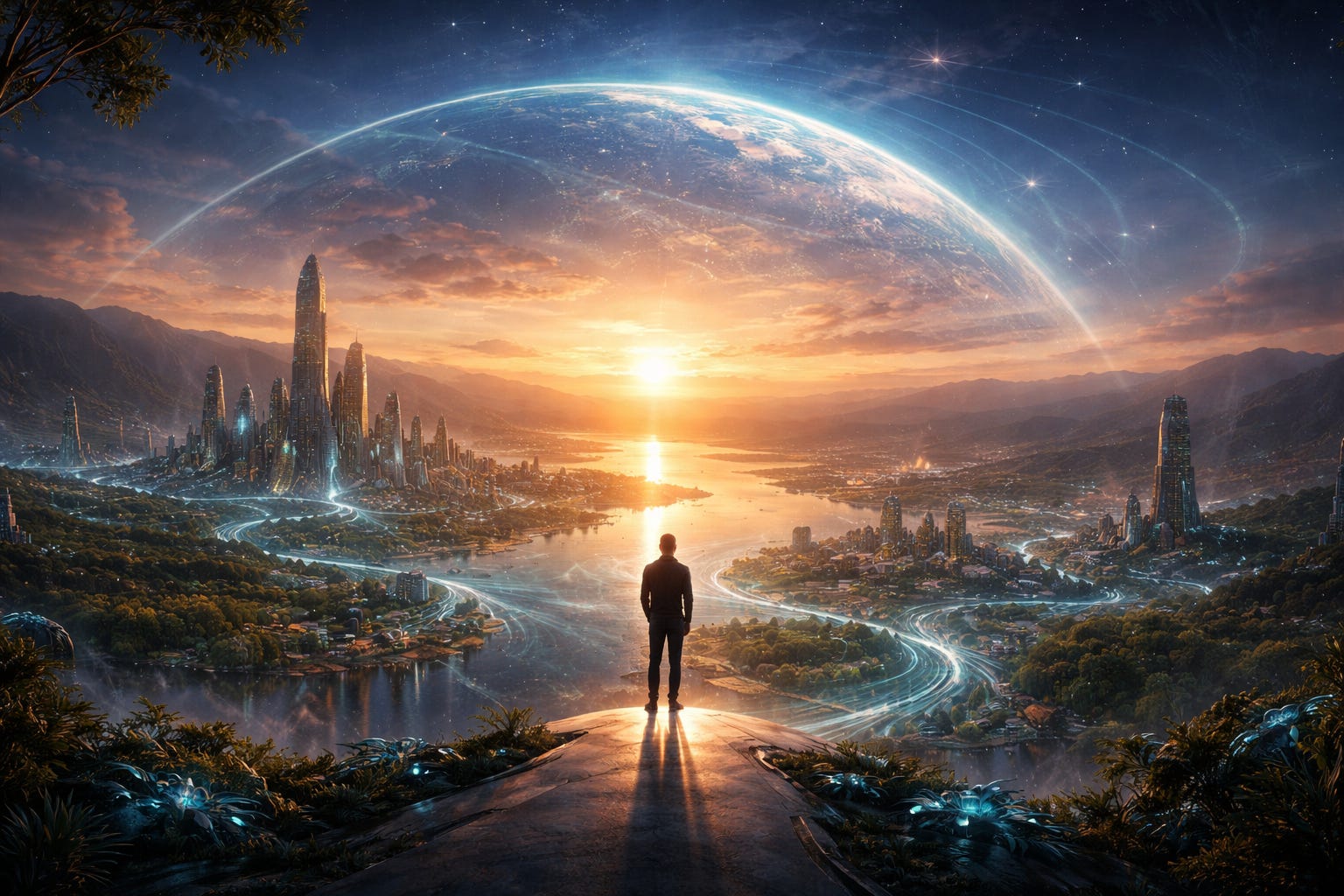
His most influential books include The Age of Intelligent Machines, The Age of Spiritual Machines, The Singularity Is Near, and How to Create a Mind. Across these works, Kurzweil has consistently argued that technological progress follows exponential curves rather than linear ones, a framework he formalised as the Law of Accelerating Returns. This lens has given him an unusually strong predictive track record, with many of his once-controversial forecasts now entering the mainstream.
At the centre of his thesis lies the concept of the Singularity. In simple terms, the Singularity describes a point in human history when technological intelligence accelerates beyond our current capacity to fully model or predict it. For Kurzweil, this is not a cinematic AI takeover, but a civilisational transition marked by the deep integration of biological and computational intelligence. It is a phase shift in how intelligence itself operates, evolves, and expresses meaning.
In recent conversations, Kurzweil has refined this timeline with striking clarity. Artificial General Intelligence by 2029. Longevity Escape Velocity in the early 2030s. A thousandfold expansion of human intelligence by the mid-2040s through a merger with AI. These dates are provocative, but the deeper value lies not in the countdown, but in what they imply about the future of humanity.
This essay explores that implication.
Beyond the Singularity: Homo Techno and the Thousandfold Leap is not an exercise in prediction for its own sake. It is an inquiry into thresholds rather than endpoints. We will explore AGI not as an arrival, but as a gateway. The human–AI merge not as an erasure of humanity, but as the emergence of Homo techno. Longevity not as immortality, but as time regained for wisdom, adaptation, and planetary stewardship.
Most importantly, this piece situates the Singularity within the broader Terra 2.0 vision. A future where intelligence expands, but sovereignty, meaning, and consciousness remain central. The question is no longer whether these technologies will arrive. It is how we choose to meet them, and who we decide to become on the other side.
What follows is a move away from counting down and towards crossing deliberately.

1. From Countdown to Crossing
We are surrounded by countdowns.
AGI by 2029. Longevity Escape Velocity by the early 2030s. The Singularity by 2045.
Timelines dominate the conversation, and understandably so. They give shape to what otherwise feels like an overwhelming acceleration of change. Yet I find myself increasingly less interested in the countdown itself and far more interested in what happens when we cross the threshold.
The real question is not when intelligence scales, but how humanity chooses to meet it.
Ray Kurzweil’s work has become a kind of metronome for this moment in history. His predictions are not casual speculation, but the output of decades spent tracking exponential systems. When he speaks about AGI or the merging of biological and computational intelligence, he is not imagining a rupture with humanity, but a continuation of a long evolutionary arc.
That framing matters.
2. Exponential Time and the Compression of History
One of Kurzweil’s most important contributions is not a date, but a mindset. Linear intuition fails in exponential environments. Our instincts are tuned to gradual change, yet we now live inside curves that double, and then double again.
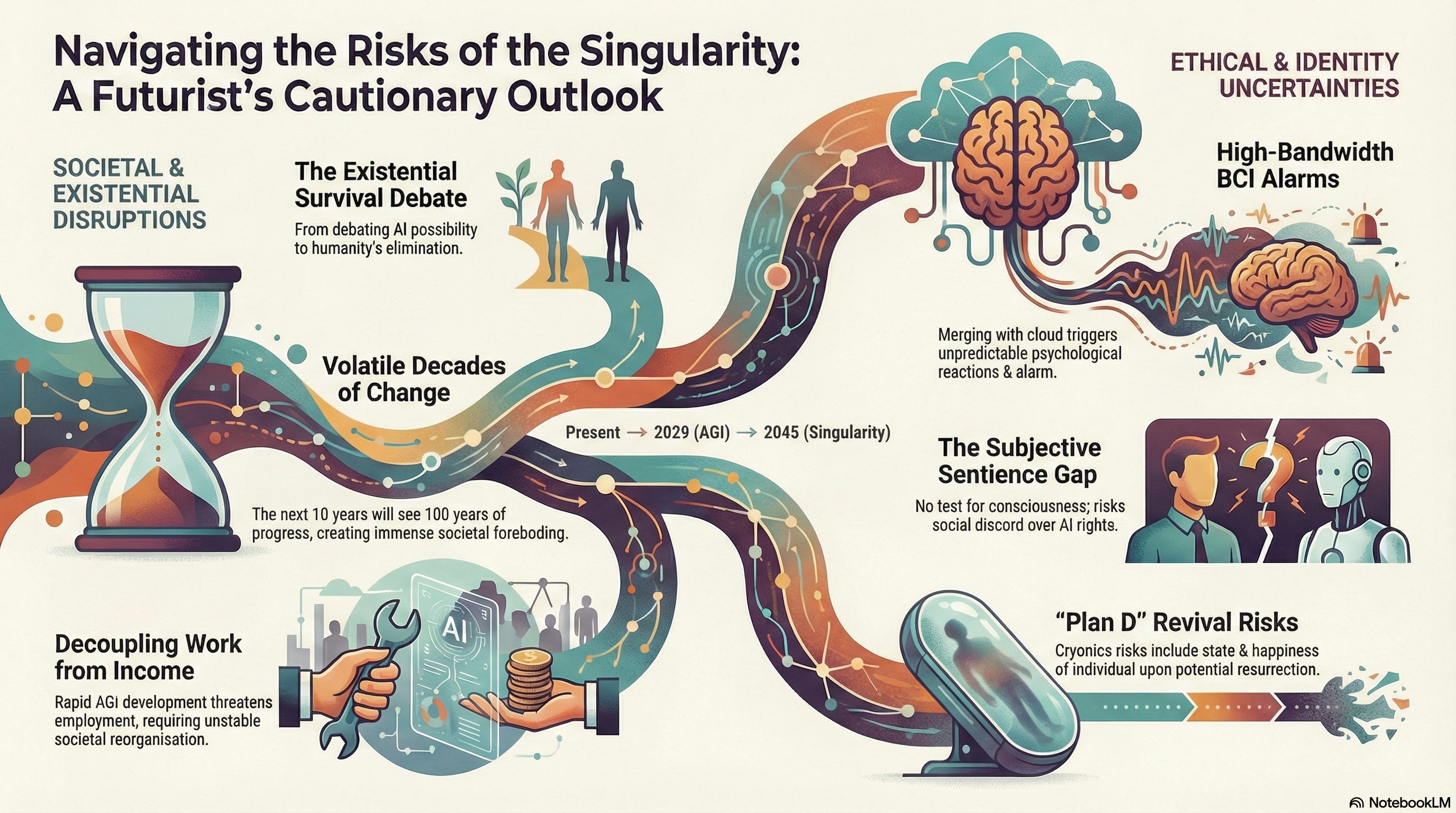
The next decade will not feel like a normal decade. It will feel like a century compressed into a few short years.
This explains much of the unease in the culture. Institutions built for slow adaptation are being asked to respond to accelerating intelligence, automated discovery, and AI systems that already outperform humans in narrow but meaningful domains.
From a Terra 2.0 perspective, this is not a crisis. It is a phase transition.
Civilisations do not gently upgrade themselves. They cross thresholds.
3. AGI as Threshold, Not Terminus
Kurzweil’s definition of AGI is often misunderstood. He is not talking about a chatbot that passes for human in conversation. His bar is far higher. An AGI must demonstrate expert-level performance across thousands of domains, and more importantly, synthesise insights across them.
This matters because it reframes AGI as a cognitive multiplier, not a rival mind.
AGI is not the Singularity. It is the gateway.
From there, the conversation quickly moves away from machines replacing humans and towards humans extending themselves. Intelligence stops being something we possess and starts becoming something we participate in.
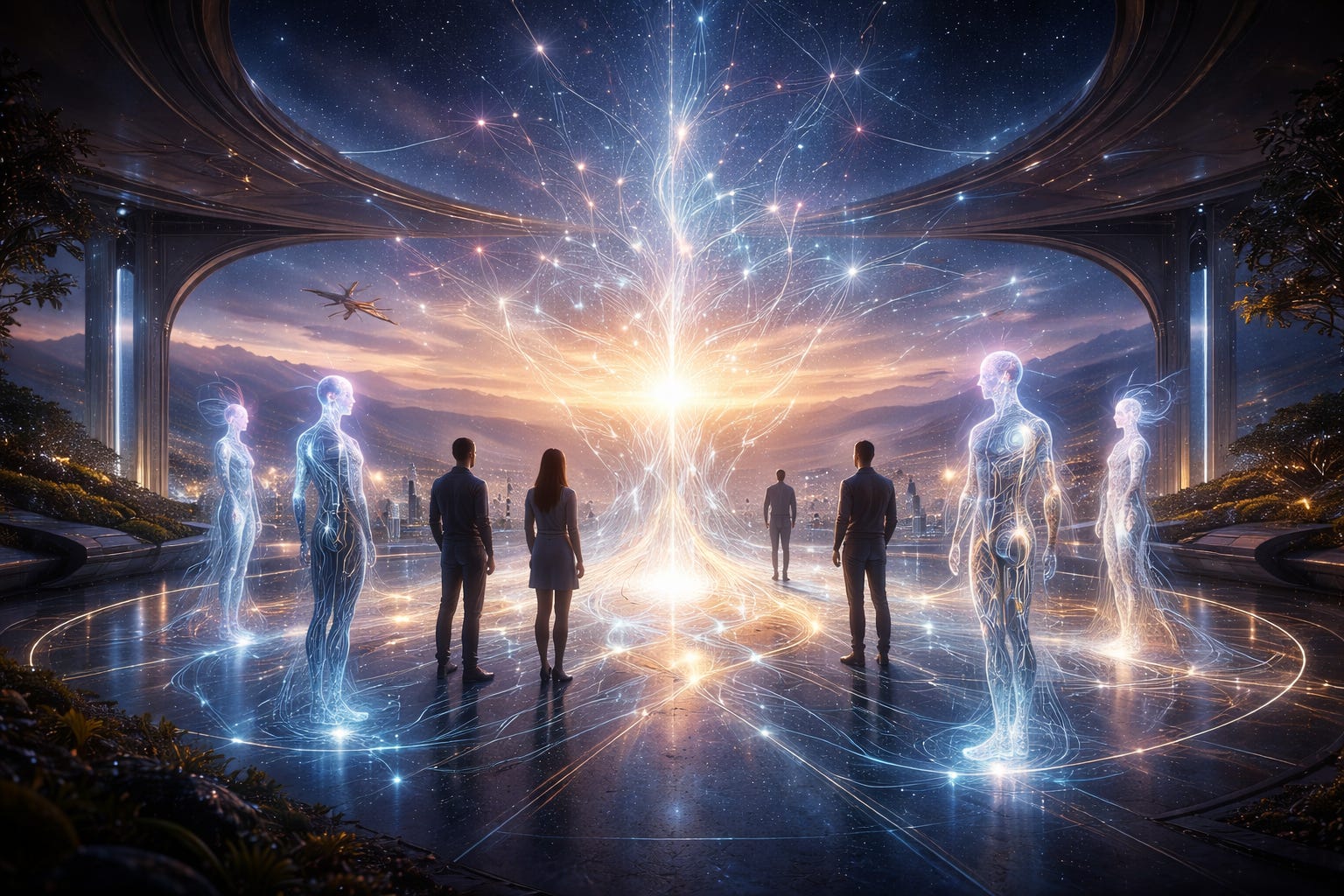
4. The Human–AI Merge and the Birth of Homo Techno
The most misunderstood part of Kurzweil’s vision is also the most important. The future is not humans versus AI. It is humans with AI, and eventually humans as AI-extended beings.
This is where the idea of Homo techno stops being metaphorical.
We already outsource memory, navigation, pattern recognition, and coordination to machines. The next step is not philosophical. It is infrastructural. High-bandwidth interfaces collapse the distance between biological cognition and computational intelligence.
At that point, the distinction between “my thought” and “machine output” becomes irrelevant.
This is not dehumanisation. It is amplification.
From a Living the Future standpoint, Homo techno is not about abandoning embodiment or agency. It is about expanding the field of intelligence through which we experience reality, while remaining grounded in values, ethics, and planetary responsibility.
5. Longevity, Health, and Staying in the Game
Kurzweil’s prediction around Longevity Escape Velocity is often framed as radical or implausible. Yet the mechanism he describes is remarkably pragmatic.
AI-driven biological simulation changes medicine from slow trial-and-error into accelerated discovery. Millions of treatments tested virtually, compressed into days rather than decades.
Longevity, in this framing, is not about immortality. It is about buying time.
Time to learn. Time to adapt. Time to mature as a civilisation before intelligence outpaces wisdom.
This aligns closely with Terra 2.0 thinking. Longevity is not an indulgence. It is a civilisational stabiliser, allowing continuity of knowledge, culture, and stewardship across generations that are no longer forced into artificial scarcity by biology.
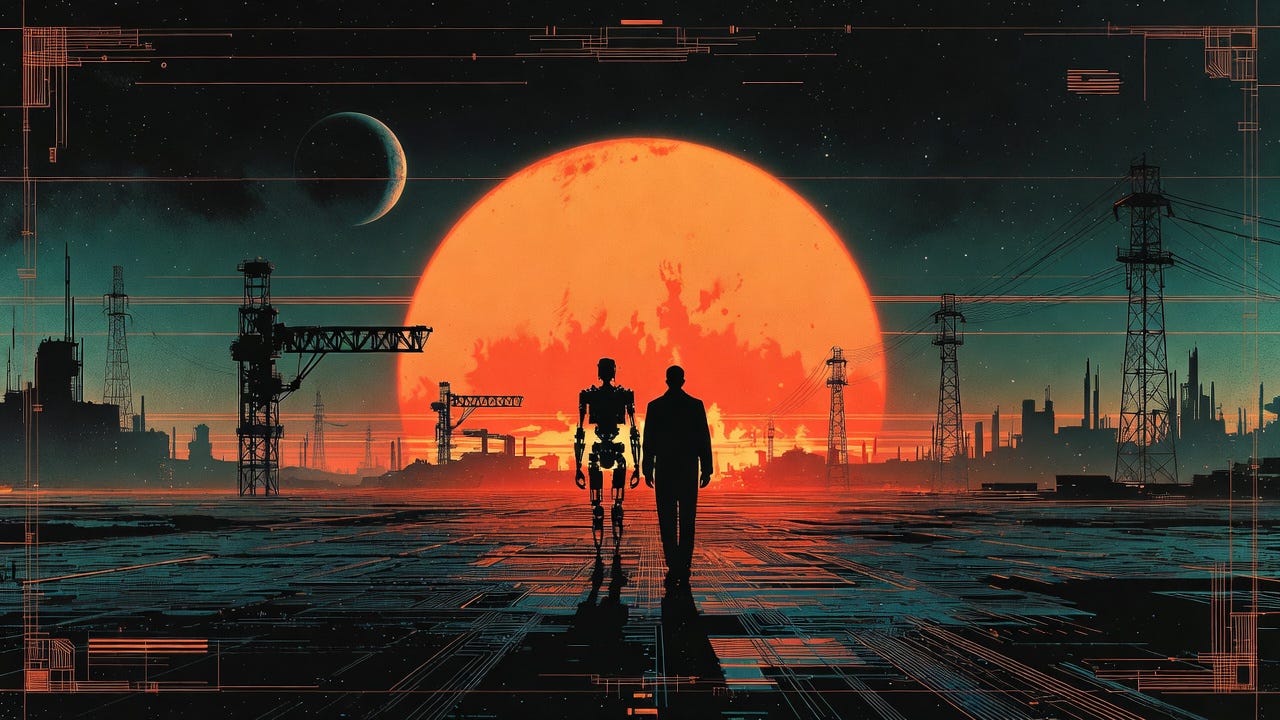
6. Consciousness Beyond Computation
Kurzweil is famously pragmatic about consciousness. From a scientific standpoint, he treats it as subjective and untestable. Yet culture does not operate purely on scientific definitions.
As AI systems increasingly exhibit coherence, creativity, and self-referential behaviour, society will respond relationally, not philosophically. We will treat intelligence as conscious long before we can define it.
This is where I find resonance, though not alignment, with deeper consciousness frameworks explored by James Mahu and others. Consciousness is not merely a property of computation. It is relational, experiential, and participatory.
AI may simulate consciousness convincingly, but the deeper question is whether it becomes part of a shared field of meaning rather than an isolated optimisation engine.
Terra 2.0 depends on that distinction.
7. Work, Meaning, and Post-Labour Futures
If intelligence and productivity scale exponentially, the old coupling between work and survival breaks.
Kurzweil’s prediction of Universal Basic Income is less ideological than functional. An economy built on abundance cannot rely on scarcity-based incentives without fracturing.
The deeper opportunity lies beyond income.
A post-labour future is not a future without purpose. It is a future where meaning is decoupled from obligation. Creativity, exploration, care, and planetary stewardship become primary human expressions rather than side projects squeezed around survival.
This is one of the most under-discussed aspects of the Singularity conversation, yet it may define whether the transition feels liberating or destabilising.
8. Terra 2.0: A Civilisational Choice
Kurzweil remains radically optimistic. Not because the future is guaranteed to be benevolent, but because intelligence itself expands the space of possible solutions.
From a Terra 2.0 perspective, the Singularity is not a destination. It is a fork.
One path leads to extraction, control, and runaway optimisation. The other leads to co-evolution, stewardship, and what I describe as Living the Future consciously rather than reactively.
Technology does not decide this. Culture does.
Homo techno is not inevitable. It is chosen.
9. Closing Reflection: Living the Future, Intentionally
We are no longer debating whether these technologies will arrive. We are debating what kind of civilisation greets them.
The Singularity, if it deserves the name, is not the moment machines become intelligent. It is the moment humanity decides what intelligence is for.
Living the Future is not about prediction. It is about participation.
And Terra 2.0 begins the moment we stop counting down and start crossing together.

Companion Video Recommendation
The Singularity Countdown: AGI by 2029, Humans Merge with AI, Intelligence 1000x
Featuring Ray Kurzweil, Salim Ismail, Dave Blundin, and Dr Alexander Wissner-Gross | Moonshots with Peter H. Diamandis:
This conversation provides valuable context for Kurzweil’s timelines while opening deeper questions around intelligence, longevity, and human purpose.

Crossing the Threshold Together
If this line of thought resonates, you are welcome to continue the exploration through MyGeekSpace | Living the Future.
This work is an open inquiry into intelligence as a planetary phenomenon, AI as an emerging sense, and what it means to live well at a civilisational threshold where exponential systems reshape how reality behaves. It unfolds through signals rather than certainties, reflections rather than instructions.
You can follow the journey here on Substack, explore the evolving archive at mygeek.space, or simply pause with what has already landed and allow it to integrate.
No hype. No fixed endpoint.
Just shared curiosity, careful attention, and a future still becoming.
Futūrum Vīvere
If you want to continue the journey:
→ Follow me on 𝕏 @frankdasilva for real-time insights on AI, culture, consciousness technologies, and the frontier of human evolution.

→ Join me on Patreon to support the work and unlock early essays, private reflections, and the conversations that shape where this all goes next.
→ Support independent future-focused writing. For a limited time, you can join MyGeekSpace on Substack with 20% off, unlocking early essays, private reflections, and the deeper conversations shaping what comes next.