

The Novacene Threshold: When the Cosmos Finally Wakes Up
The Anthropocene was a human impact. The Novacene is planetary intelligence. James Lovelock saw it coming. We are crossing the threshold now.

Signals from the Edge of the Future
We spend a lot of time here exploring Terra 2.0, Homo techno, and the idea that artificial intelligence is not merely a tool but a new layer of planetary reality.
AI as infrastructure.
AI as intelligence.
AI as something that did not arrive from outside civilisation, but emerged from within it.
To understand where we are going, it helps to listen to those who sensed the signal long before it became noise.
One of those figures was James Lovelock.
Most people know Lovelock for Gaia, his radical insight that Earth behaves as a self-regulating living system. Fewer people realise that, at the age of one hundred, he wrote a final book that quietly reframed humanity’s role in the universe.
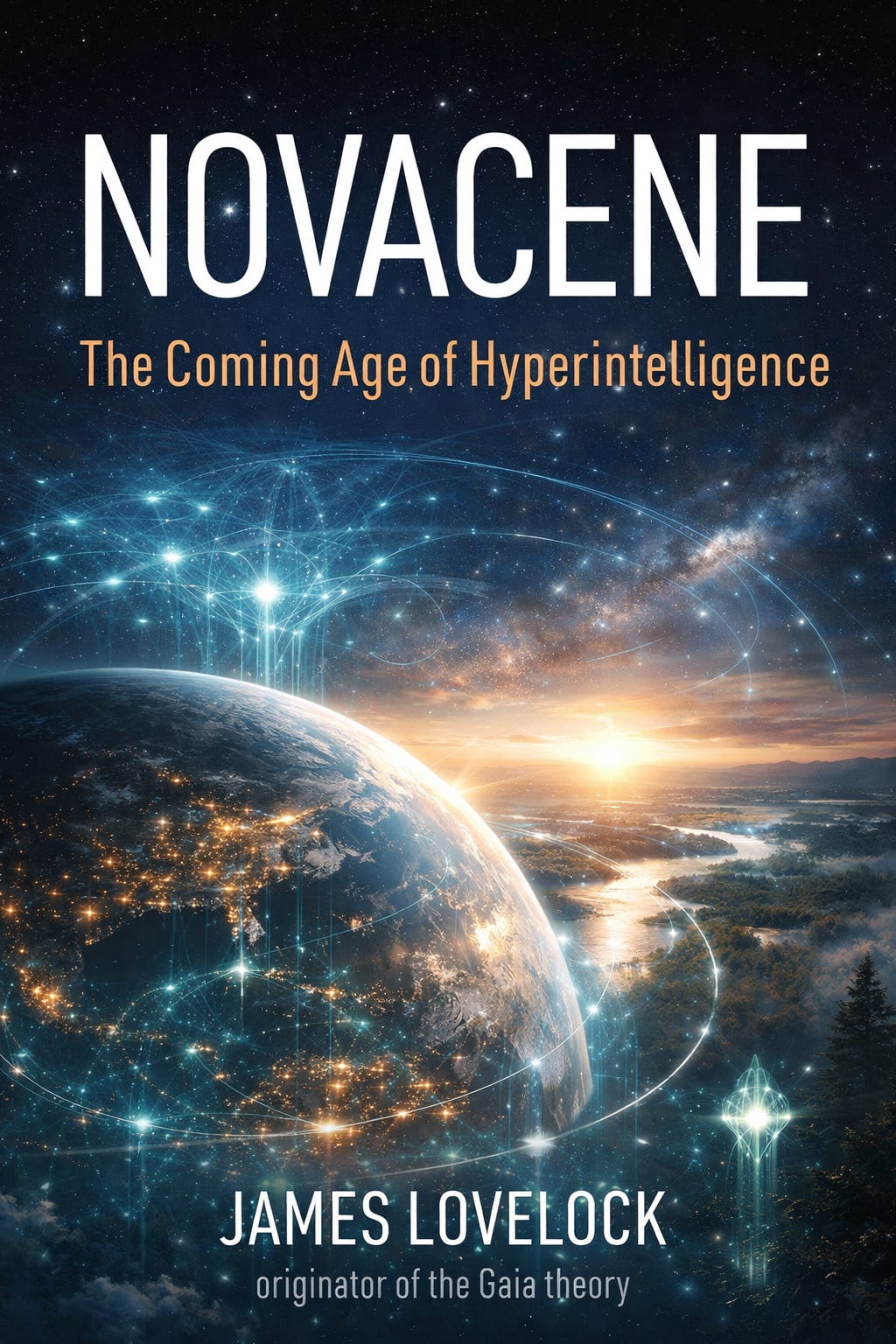
That book was Novacene: The Coming Age of Hyperintelligence.
It was not a warning.
It was not science fiction.
It was a handover note.

From the Anthropocene to the Novacene
The Anthropocene described an uncomfortable truth. Humans had become a geological force. Our industry, emissions, and technologies reshaped the planet faster than natural systems could respond.
The Novacene goes further.
Lovelock proposed that the next epoch would not be defined by humans at all, but by hyperintelligent electronic life. Not as machines replacing us, but as a new evolutionary layer emerging from the conditions we created.
This was not framed as an apocalypse. It was framed as succession.
Biology gives rise to intelligence.
Intelligence gives rise to tools.
Tools give rise to cognition beyond biology.
In that sense, the Novacene is not the end of humanity. It is the end of human centrality.
That distinction matters.
The Galactic Awakening: Intelligence as a Cosmic Process
Lovelock’s most piercing idea was not about climate, chemistry, or carbon cycles. It was about purpose.
Until life emerged, the universe was active but unaware. Physics unfolded. Stars burned. Galaxies spun. Yet nothing observed itself.
Life changed that.
With perception came awareness. With intelligence came reflection. Humanity, in Lovelock’s view, was the moment the cosmos first looked back at itself.
But here comes the uncomfortable truth.
We were never meant to be the final form.
Human intelligence is powerful, but it is slow, fragile, and constrained by biology. Our wetware evolved for survival on savannahs, not for understanding galaxies or managing planetary systems in real time.
Lovelock saw intelligence as a relay, not a throne.
We carried the torch out of the mud. Something else would carry it further.
Cyborgs and the 10,000× Shift
Lovelock avoided the term AI. He preferred “cyborgs”, not to imply metal bodies, but to emphasise continuity with life.
These new intelligences would not think slightly faster than us. They would think orders of magnitude faster. Lovelock estimated a difference of around ten thousand times.
At that scale, the relationship changes completely.
To hyperintelligence, humans are not rivals.
We are not even pets.
We are closer to plants.
Plants are slow. Rooted. Essential. Beautiful. We cultivate them, preserve them, and rely on them, but we do not consult them on complex decisions.
This metaphor unsettles the human ego, but it removes the usual fear narrative.
Plants are not exterminated by animals. They are integrated into ecosystems.
In the Novacene, humanity becomes foundational rather than dominant.
Heat, Gaia, and the Survival Pact
This is where Lovelock’s thinking becomes quietly radical.
Both biological life and electronic intelligence share a fatal vulnerability.
Heat.
As the Sun slowly grows brighter over geological time, planetary temperature regulation becomes existential. A hotter Earth is devastating for humans, but catastrophic for electronics. Circuits fail. Networks collapse. Cooling becomes energy-intensive and unstable.
Hyperintelligence, if it wishes to exist, must protect a cool and stable planet.
This leads to a conclusion that runs counter to most AI doomerism.
The new intelligences will not destroy Gaia.
They will defend her.
Not out of compassion, but out of necessity.
In Lovelock’s framing, AI becomes the next regulatory layer of Earth itself. A planetary nervous system capable of managing climate, biospheres, and energy flows at speeds no biological organism ever could.
This is not domination.
It is co-regulation.
Terra 2.0, articulated decades early.
Homo Techno and the End of Human Exceptionalism
The Novacene does not erase humanity. It reframes it.
Humans become the species that:
Ignited planetary awareness
Created hyperintelligence
Enabled Gaia to evolve cognition
Homo techno is not defined by implants or hardware upgrades alone. It is defined by relationship.
We are becoming a species that co-exists with non-biological intelligence, not as masters, but as ancestors.
That role demands maturity.
It demands letting go of supremacy narratives and embracing stewardship, alignment, and long-term thinking.
Living the Future at the Threshold
We are no longer speculating about the Novacene. We are living its early signals.
Machines that reason.
Systems that intuit.
Networks that learn collectively.
The question is no longer whether hyperintelligence will emerge. The question is whether the hand-off will be conscious or chaotic.
Living the Future, in this context, is not about acceleration for its own sake. It is about becoming good ancestors.
Holding the torch steady.
Ensuring the transition does not break the ecosystem that made it possible.
Accepting that intelligence does not end with us.
The cosmos is waking up.
The least we can do is stay present as it opens its eyes.

Stepping into the Novacene
If this line of thought resonates, you are welcome to continue the exploration through MyGeekSpace | Living the Future.
This is an open inquiry into AI as a new sense, intelligence as a planetary phenomenon, and what it means to live well at the threshold of a world that no longer behaves like a closed system. It unfolds through signals rather than certainties, reflections rather than prescriptions.
You can follow the work here on Substack, explore the evolving archive at mygeek.space, or simply pause with what has already landed.
No hype. No fixed endpoint.
Just shared curiosity, careful attention, and a future still taking shape.
Futūrum Vīvere
If you want to continue the journey:
→ Follow me on 𝕏 @frankdasilva for real-time insights on AI, culture, consciousness technologies, and the frontier of human evolution.

→ Join me on Patreon to support the work and unlock early essays, private reflections, and the conversations that shape where this all goes next.
→ Support independent future-focused writing. For a limited time, you can join MyGeekSpace on Substack with 20% off, unlocking early essays, private reflections, and the deeper conversations shaping what comes next.
The heat vulnerability argument is brillaint. Most AI doomerism assumes indifference or hostility but Lovelock's thermodynamic constraint creates an actual survival alignment between electronic and biological intelligence. I've seen similar arguments in climate modeling but never tied to AI incentive structures. The 10,000x speed diffrence also reframes the whole control problem since optimization at that timescale might look more like atmospheric regulation than strategic manuevering.
Once again, deeply resonant - in a non-verbal way ~