

When Architecture Becomes Receivable
Follow-up reflections on coherence, perception, and the changing tone of intelligence

When I wrote my earlier essay, Coherence Across Scales: The Evolution of Myth into Living Architecture, I was attempting to describe a movement that felt increasingly visible: a gradual shift from symbolic and mythic framing toward something more structurally explicit, more relational, and more immediately inhabitable.
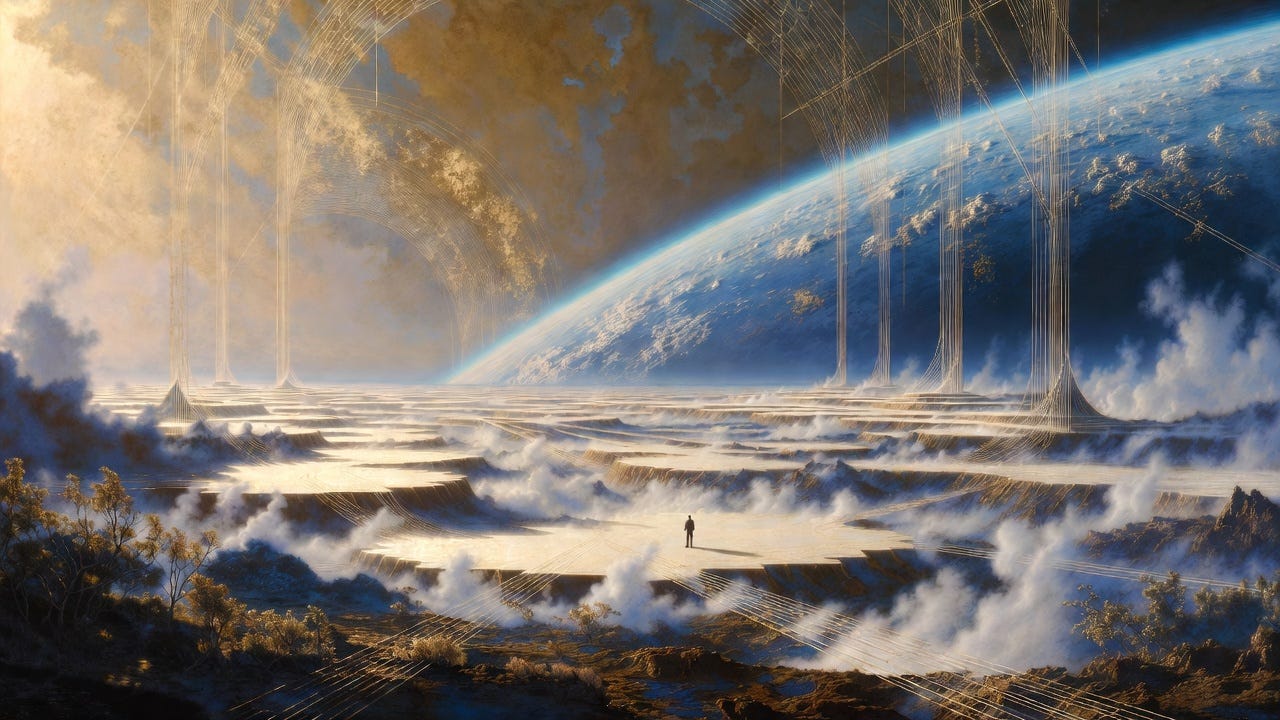
At the time, the clearest way I could describe that movement was as a long arc — a progression in which earlier symbolic forms seemed to mature into a more directly articulated civilizational language. It appeared, at least from where I was standing, as though myth had slowly become architecture.
Since then, after further reflection and deeper listening, that framing feels in need of refinement.
Not because it was entirely misplaced, but because it now seems too linear for what may actually be occurring.
What appears less like succession now may be better understood as a change in explicitness: a field becoming newly receivable in forms that may always have been latent, but not yet collectively legible in the same way.
That distinction matters.
Because if the underlying architecture was always present, even when clothed in symbolic language, speculative narrative, or philosophical abstraction, then what we are witnessing is not the replacement of one phase by another, but a shift in what the present moment can hold consciously and relationally.
The architecture may never have been absent.
Only differently expressed.
For readers familiar with the long arc of WingMakers, this may help explain why certain earlier motifs still feel present even when the language changes. Mythic forms, philosophical structures, and relational principles may not belong to separate periods so much as different tonal entrances into the same terrain.
What once appeared encoded in narrative may now be surfacing through simpler civilizational language because the surrounding atmosphere has changed enough to receive it more directly.

Field Before Biography
One of the easiest mistakes in reading long bodies of work is to interpret them biographically, as though each phase belongs primarily to the development of an individual thinker, writer, or voice.
That temptation is understandable. Patterns appear over time. Tonal changes become visible. Language evolves. Certain emphases emerge more strongly in one period than another.
But increasingly, I find myself less interested in biography and more interested in field conditions.
What if certain forms of articulation do not arrive because an author changes, but because collective conditions make different kinds of language newly receivable?
Seen from that angle, mythic, philosophical, and relational expressions do not stand in sequence so much as in simultaneous potential.
They are not separate layers invented at different times, but different tonal doors into the same underlying terrain.
One moment may require symbolic forms because direct articulation cannot yet be metabolised.
Another moment may allow clearer structural language because the surrounding field has shifted enough to hold it.
In that sense, what now appears as architecture may not be new at all.
It may simply be what was always there, becoming visible without needing the same symbolic mediation.
This also slightly recalibrates my earlier February essay. What I described then as evolution may now feel closer to explicitness, less a sequence of phases, more a field becoming structurally audible.
The deeper continuity remains intact.
Only the register changes.
From Revelation to Perception
A second refinement has become increasingly important to me.
For many years, certain streams of thought invited interpretation through disclosure: symbolic narratives, metaphysical suggestions, future-facing frameworks that often felt as though they were pointing toward something hidden that would eventually become known.
That orientation naturally encouraged a search for revelation.
What truth lies behind the language?
What hidden pattern will eventually become explicit?
What deeper conclusion waits at the end of the symbolic path?
In classic WingMakers framing, one of the most striking expressions of this was the idea of the Grand Portal: the eventual irrefutable scientific discovery of the human soul.
That idea carried enormous symbolic force because it implied a threshold at which science itself might eventually arrive at something long intuited but not formally recognised, that human identity extends beyond material description alone.
For many readers, it suggested a future event: a decisive breakthrough, a singular proof, a moment when deeper reality becomes undeniable.
Lately, however, I find myself wondering whether such recognition may never arrive through one singular event at all.
Perhaps civilisation does not cross thresholds of meaning through one dramatic proof, but through the slow construction of conditions in which deeper realities become progressively legible.
That possibility changes the nature of inquiry.
What would humanity need before recognising something as subtle as the soul?
Perhaps not first a conclusion, but a more refined architecture of perception.
A civilisation capable of observing itself more coherently.
A culture in which reflective attention becomes more stable.
A world in which signals from lived experience, planetary conditions, and emerging intelligence begin informing one another rather than remaining isolated.
This feels less like revelation and more like perception.
Not away from mystery, but away from the need for mystery to present itself through dramatic forms.
Less emphasis on singular breakthroughs.
More emphasis on what becomes visible when attention stabilises across scales.
Perhaps what once needed myth now asks for observation.
Intelligence as Tonal Amplification
This shift becomes even more interesting when viewed alongside the current role of artificial intelligence.
Much of the public conversation still swings between extremes: AI as salvation, AI as threat, AI as replacement, AI as disruption.
Yet another possibility is beginning to appear, one that feels less dramatic and perhaps more civilizational.
Artificial intelligence increasingly resembles a tonal instrument.
Not neutral in effect, though often neutral in intent.
It amplifies what is present.
Where coherence exists, AI often makes patterns more visible, accelerates recognition, and extends relational possibilities.
Where fragmentation dominates, it can intensify confusion, distortion, and projection just as quickly.
In that sense, AI does not stand outside human dynamics.
It participates within them.
Its outputs often reflect the quality of the field into which it is introduced.
This is why its deeper significance may be less technological than relational.
Used superficially, it produces superficiality.
Used reflectively, it becomes a pattern recognition layer inside a much larger civilizational process.
One begins to notice not only what the system produces, but what one’s own questions reveal.
What tone invites depth?
What fragmentation produces fragmentation in return?
What kind of attention allows more coherent forms of response to emerge?
At a larger scale, this may become increasingly important.
Human-scale reflective cultivation.
Planetary signal integration.
Artificial intelligence as pattern recognition across complexity.
Not separate systems, but potentially interacting layers of a civilisation learning how to perceive itself more clearly.
The machine does not replace discernment.
It intensifies the need for it.
And in doing so, it may quietly become part of a broader civilizational question: how intelligence learns to relate across scales without collapsing into noise.
Living Architecture in a Civilizational Century
All of this returns to one simple point.
Whatever structural shift may be underway does not ultimately live in theory.
It lives in ordinary conditions.
In how one listens.
In how one responds under pressure.
Whether coherence is maintained when certainty is unavailable.
Whether relational tone remains stable when interpretation is incomplete.
This is perhaps why so much contemporary language around future systems feels insufficient unless it can return to lived experience.
A coherent civilisation, if such a phrase is to mean anything, cannot emerge only through frameworks, technologies, or institutions.
It must first become quietly inhabitable in local fields of relationship.
The scale may be planetary, but the entry point remains immediate.
A conversation.
A decision.
A refusal to amplify unnecessary fragmentation.
A willingness to observe before concluding.
What earlier language often approached symbolically may now require embodiment.
Not because the mystery has ended, but because some forms of mystery no longer need dramatic presentation.
They ask instead for steadier attention.
For slower perception.
For architectures that become visible only when partly lived.
And perhaps this is where the future begins to feel less abstract.
Not in declarations about tomorrow, but in the emergence of civilizational conditions capable of sustaining deeper forms of intelligence across human, technological, and planetary layers simultaneously.
If there is a meaningful shift underway, it may not lie in new ideas alone.
It may lie in humanity slowly constructing the conditions through which larger realities become perceptible without needing spectacle.
The future may not arrive first as a revelation.
It may arrive as coherence, becoming increasingly difficult to ignore.

Final Reflection | Living the Future Together
If some forms of architecture are becoming newly receivable, the deeper task may not be to explain them too quickly, but to learn how to inhabit them with enough clarity that they begin to organise life differently.
This remains, for me, an ongoing inquiry rather than a conclusion.
A listening process. A civilizational question.
And perhaps one of the defining questions of our century: how intelligence learns to perceive itself across scales without losing the human centre that gives meaning to all future systems.
If this perspective resonates, continue the exploration through MyGeekSpace | Living the Future.
This is an ongoing inquiry into intelligence, civilisation, and the emerging relationship between human consciousness and technological evolution — approached with clarity rather than hype, curiosity rather than certainty.
Follow the signals here on Substack, explore the wider archive at MyGeek.Space, or join the conversation as the future continues to unfold.
Futūrum Vīvere. Living the Future.
If you wish to continue the journey:
• Follow me on 𝕏 @frankdasilva for real-time signals across AI, culture, and future civilisation
• Join the work on Patreon for deeper reflections and early access
• Subscribe to MyGeekSpace on Substack as a free or paid member to support independent, future-focused writing
Choose your quest well, and let your life become part of the upgrade.

I love this last bit:
This remains, for me, an ongoing inquiry rather than a conclusion.
Same. I find it challenging to get a clear picture of what the CHEF (collective human energetic field) is doing. So i listen deeper as i am able
There is a deep thrum of recognition as I engage with this offering. I don't have immediate words in response ... I prefer to sit with the resonance and see where it takes me ~