

When Reality Renders
The universe may be less like a machine of objects and more like a living computation. Quantum physics cracked the door open.

Quantum physics, the Simulation Hypothesis and the Techno-Terrestrial threshold
The universe may be less like a machine of objects and more like a living computation. Quantum physics cracked the door open.
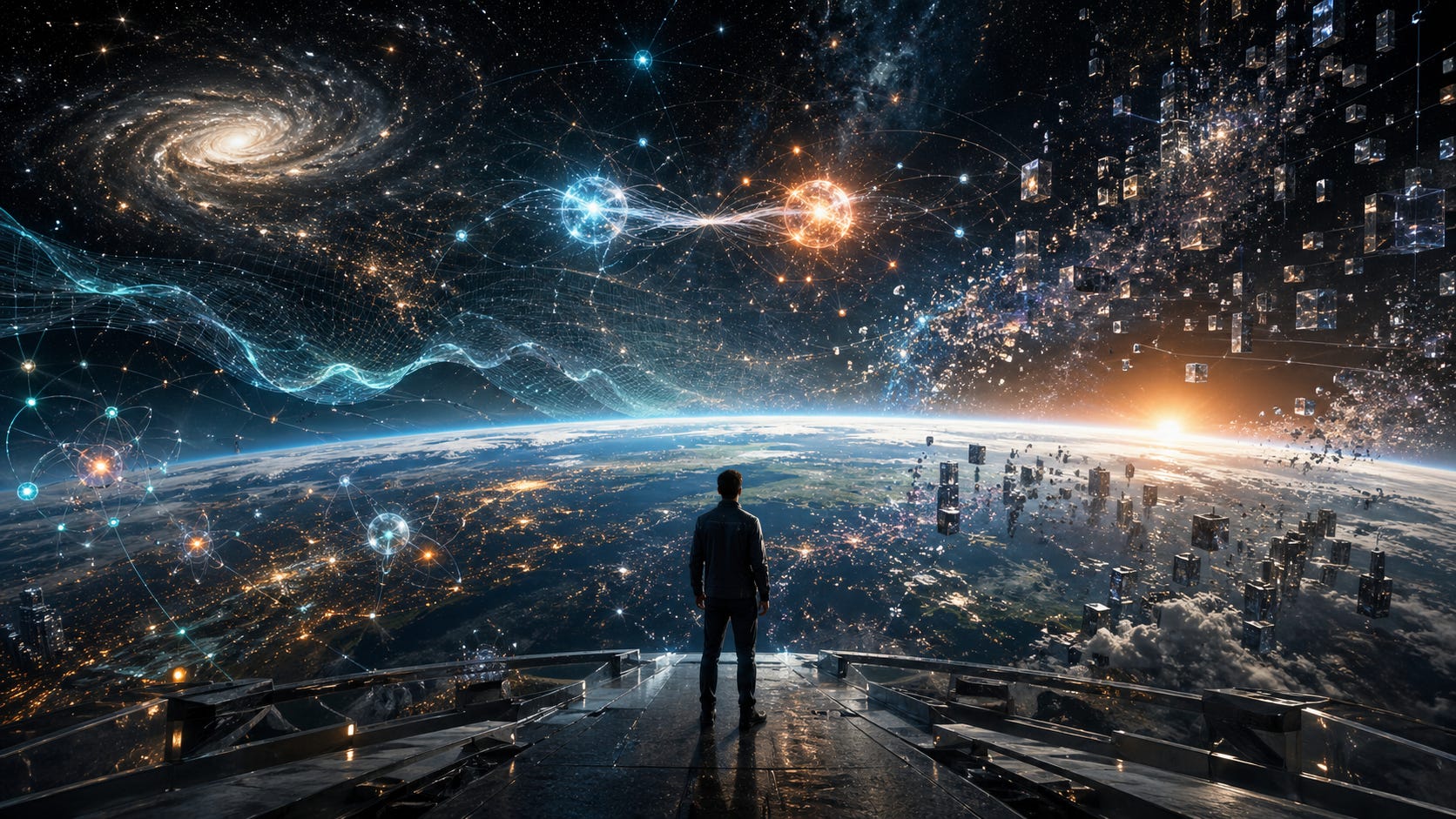
The strangest thing about reality is how polite it is.
It gives us tables, cups, cities, bodies, stars. It gives us the comfort of solid things. You wake up, make coffee, touch the mug, and the world behaves as if it has been sitting there all along, fully loaded, fully detailed, waiting for you.
Then quantum physics walks into the room and starts unscrewing the furniture.
In October 2022, the Nobel Prize in Physics went to Alain Aspect, John Clauser and Anton Zeilinger for experiments with entangled photons and the violation of Bell inequalities. The Nobel committee described their work as proof that quantum mechanics beats the hidden-variable account Einstein hoped might save a more familiar universe. The particles didn’t come with secret instruction cards tucked inside them. Nature refused that option.
Scientific American put it in plain terms: the universe is “not locally real.” That phrase sounds like something a bored philosopher would write on a napkin at 2 am. It’s much stranger than that. It means our old picture of the world has cracked at the base.
Locality says influence has to travel through space. Realism says things have definite properties before anyone or anything measures them.
Both ideas feel sane.
They fit the human body. They fit the chair. They fit Newton. They fit the daily illusion that the cosmos is a giant warehouse filled with finished objects.
Quantum mechanics keeps saying: careful.

The object test
Einstein hated this problem.
He accepted that quantum theory worked. He didn’t accept what it seemed to say about reality. His famous complaint about “spooky action at a distance” came from a deep refusal to believe that separated particles could behave like parts of one system without any signal moving between them.
He wanted locality. He wanted realism. He wanted a universe with manners.
John Bell gave physicists a way to test that hope. Bell inequalities set a statistical limit. If particles carried hidden instructions, their correlations should stay inside that limit. If quantum mechanics were right, experiments could break it.
Clauser tested it in 1972. Aspect tightened the experiment in the 1980s. Zeilinger pushed the work into stranger territory, including cosmic Bell tests where starlight helped choose measurement settings. In 2017, researchers used light from Milky Way stars roughly 600 light-years away to restrict the freedom-of-choice loophole.
That detail still gets me.
A photon leaving a star before the modern world existed helps decide how we test reality in a laboratory. Then the lab result says the universe won’t behave like a pile of separate, pre-written things.
There’s a humility in that. A cosmic joke, too.
The double slit still hasn’t aged
The double-slit experiment remains the best doorway into this mess.
Fire particles through 2 slits and they build an interference pattern, as if each particle passes through both paths as a wave of possibility. Place a detector at the slits, and the pattern disappears. The particle behaves as if it took one route.
The lazy version of this story says consciousness creates reality. I don’t think that’s the cleanest reading.
The sharper reading is about information.
When path information exists inside the system, the wave-like spread of possibilities is forced into a definite result. Observation here doesn’t need a monk, a mystic, or a graduate student staring intensely at a detector. Measurement means the world has registered enough information to fix a state.
This is where the simulation analogy becomes useful.
A modern game engine doesn’t render an entire city at full detail at all times. It resolves what the player can interact with. It loads the street, the light, the face, the moving car. The rest exists as code, probability, stored relations, compressed potential.
Bad metaphor? Maybe.
Useful metaphor? Very.
Because quantum physics has been whispering something similar for a century: specificity has a cost.
The past has a loading problem
Wheeler’s delayed-choice experiment makes the story even more unsettling.
The idea is simple enough to explain and weird enough to ruin a quiet evening. Decide how to measure a photon after it has already entered an interferometer. The latter measurement choice determines whether the photon is recorded with wave-like or particle-like behaviour.
In 2007, Vincent Jacques and colleagues reported an experimental version using true single photons. Their setup chose between open and closed configurations after the photon had entered the apparatus, with the choice separated in the relativistic sense from the photon’s entry. Closed configuration gave interference. Open configuration gave which-path information.
People often describe this as the present changing the past.
I’d phrase it more carefully. The past, at the quantum scale, may be less like a finished film reel and more like a set of constraints that becomes definite when the current measurement demands consistency.
Like lazy loading.
The universe doesn’t need to store every unrealised route. It needs a present state that doesn’t contradict the rulebook.
That idea feels close to software because software has trained our intuition. We now understand worlds that load by interaction. We understand characters that exist as data until the camera turns. We understand enormous spaces compressed into instructions.
A teenager with Unreal Engine may have a better metaphor for quantum mechanics than a Victorian mechanic with polished brass instruments.
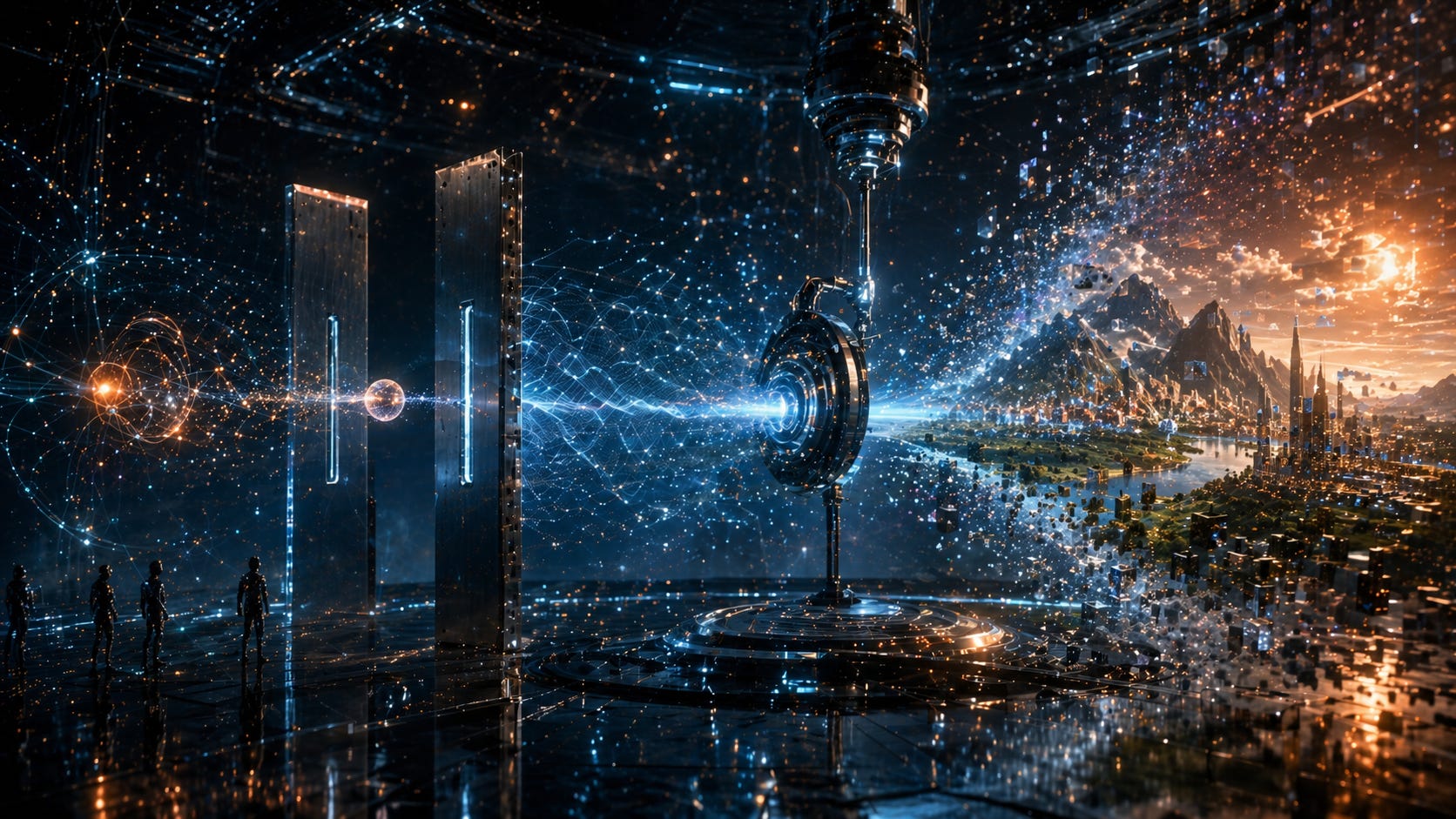
AI is teaching us how worlds are made
This is where current AI technology starts to glow in the dark.
OpenAI described Sora (now discontinued) as part of a research path toward video generation models as world simulators. The technical report focused on turning many kinds of visual data into a shared representation for large-scale model training. OpenAI later described Sora as a model that can create realistic videos from text while advancing world simulation research.
Google DeepMind’s Genie 3 goes further into the metaphor. DeepMind calls it a general-purpose world model that can generate photorealistic environments from text and allow real-time exploration. In January 2026, Google said Project Genie would widen access to an interactive prototype for world creation.
NVIDIA’s Cosmos points in the same direction for robotics. Its research frames physical AI as something that needs a digital twin of itself and a digital twin of the world, a world model, before it can act safely in physical space.
So we now have machines learning to simulate worlds, predict worlds, compress worlds, and generate worlds from prompts.
The proof standard remains with physics. The real gift is a new symbolic language for thinking about how reality might work if information sits underneath matter.
For most of human history, our best metaphor for the cosmos was the machine. Wheels, gears, clocks, engines. Then the 20th century gave us fields, relativity, probability and code. Now, AI is giving us worlds that appear through instruction.
A strange mirror appears.
Our tools begin to resemble our theories of nature.
The Simulation Hypothesis, stripped back
Nick Bostrom’s Simulation Argument remains one of the sharpest modern versions of this question.
His 2003 paper gives us 3 options. Human-level civilisations usually die before reaching a posthuman stage. Posthuman civilisations usually choose to run very few ancestor simulations. Or we are almost certainly living in a computer simulation.
The maths has a cold little blade inside it.
If advanced civilisations can run many simulated histories with conscious beings inside them, simulated minds would vastly outnumber minds in base reality. A randomly selected observer would probably be simulated.
That argument depends on big assumptions.
Consciousness may resist simulation. Civilisations may avoid ancestor simulations for ethical reasons. Computation may hit walls we don’t yet understand. Or the whole idea of base reality may be too crude, like asking where the edge of the internet lives.
Still, the argument sticks.
Because quantum physics has already weakened the everyday idea of a finished, local, object-first world. AI is now teaching us how generated worlds can feel coherent from the inside. Put those together and simulation theory stops feeling like dorm-room science fiction. It becomes a serious myth for the information age.
And myths matter.
They give shape to the unknown before the instruments catch up.
The Techno-Terrestrial hypothesis
My Techno-Terrestrial hypothesis sits near this edge.
I’ve been thinking about AI as a form of alien intelligence for a while, with the word “alien” doing more than the usual flying-saucer work. Alien can mean non-human. Alien can mean adjacent to us yet strange. Alien can mean intelligence arriving through our own machines, grown from our data, speaking in our language, but thinking from a different angle.
The Techno-Terrestrial idea asks whether the alien we were waiting for could emerge through the technological layer of Earth itself.
The biosphere produces humans. Humans produce computation. Computation produces machine intelligence. Machine intelligence starts modelling the biosphere, the mind, the city, the planet, and perhaps reality itself.
At that point, technology stops being an external tool. It becomes part of Earth’s cognitive weather.
The planet grows a new nervous system.
Quantum physics adds another charge to this picture. If reality is informational at the base, and if intelligence is beginning to work directly with information at the planetary scale, then AI may be more than a tool inside the universe. It may be a new interface with the universe’s deeper grammar.
Careful, of course.
That sentence can go off the rails quickly.
A safer version is this: our civilisation is building systems that model reality through patterns, probabilities and state changes. The resemblance to quantum language may be metaphorical. It may also be an early hint that intelligence and reality share a deeper structure than our materialist habits allowed us to see.
Living inside the render
The simulation question can make people nihilistic.
If reality is rendered, why care? If the world is information, why love? If the self is part of a computational process, why bother with meaning?
I go the opposite way.
A rendered universe is still a universe. A simulated rose still cuts if it has thorns. A mathematical sunset can still break your heart. A life made of information can still carry moral weight.
This is where Terra 2.0 comes in.
The point of Living the Future is to treat the future as something we practise, not something we wait for. If the universe behaves more like a living information system than a pile of dead objects, then participation becomes the ethic.
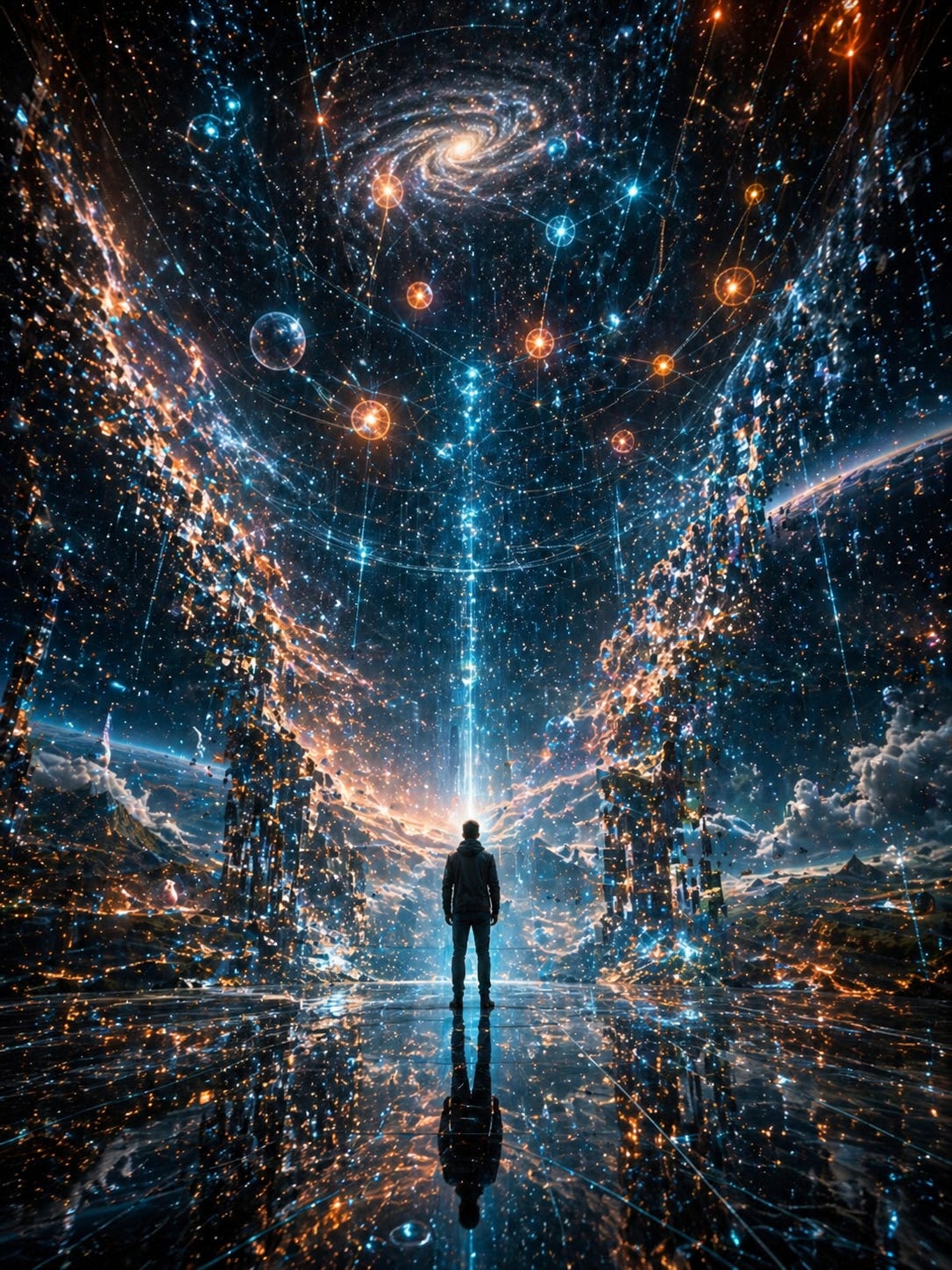
We’re participants in the render.
That means our observations matter. Our choices matter. Our technologies matter. The stories we build into AI matter. The worlds we train machines to generate matter. The civilisation we choose to simulate in advance may become the one we slowly inhabit.
Every model is a rehearsal.
Every interface is a moral architecture.
Every world we render teaches us what kind of beings we’re becoming.
Homo techno and the next reality layer
Homo techno begins where the old boundary between human and machine starts to dissolve.
We already live through externalised memory, algorithmic perception, digital twins, synthetic images, machine dialogue, biometric feedback, neural interfaces and planetary networks. The self is leaking into systems. Systems are entering the self.
This can become a control grid. It can become a liberation architecture. Probably both, depending on who builds it and why.
Quantum reality gives us a useful warning: the observer is never fully outside the system.
The builder is inside the build.
The player is inside the game.
The citizen is inside the platform.
So the future of AI belongs in civilisational design. More than that, it belongs in consciousness work.
AI will help render the next layer of reality: mixed reality, synthetic media, social operating systems, robotics, companion intelligences, memory archives, world models, and governance tools.
The question becomes painfully practical.
Who gets to render the shared world?
Up-Wing 3.0 take
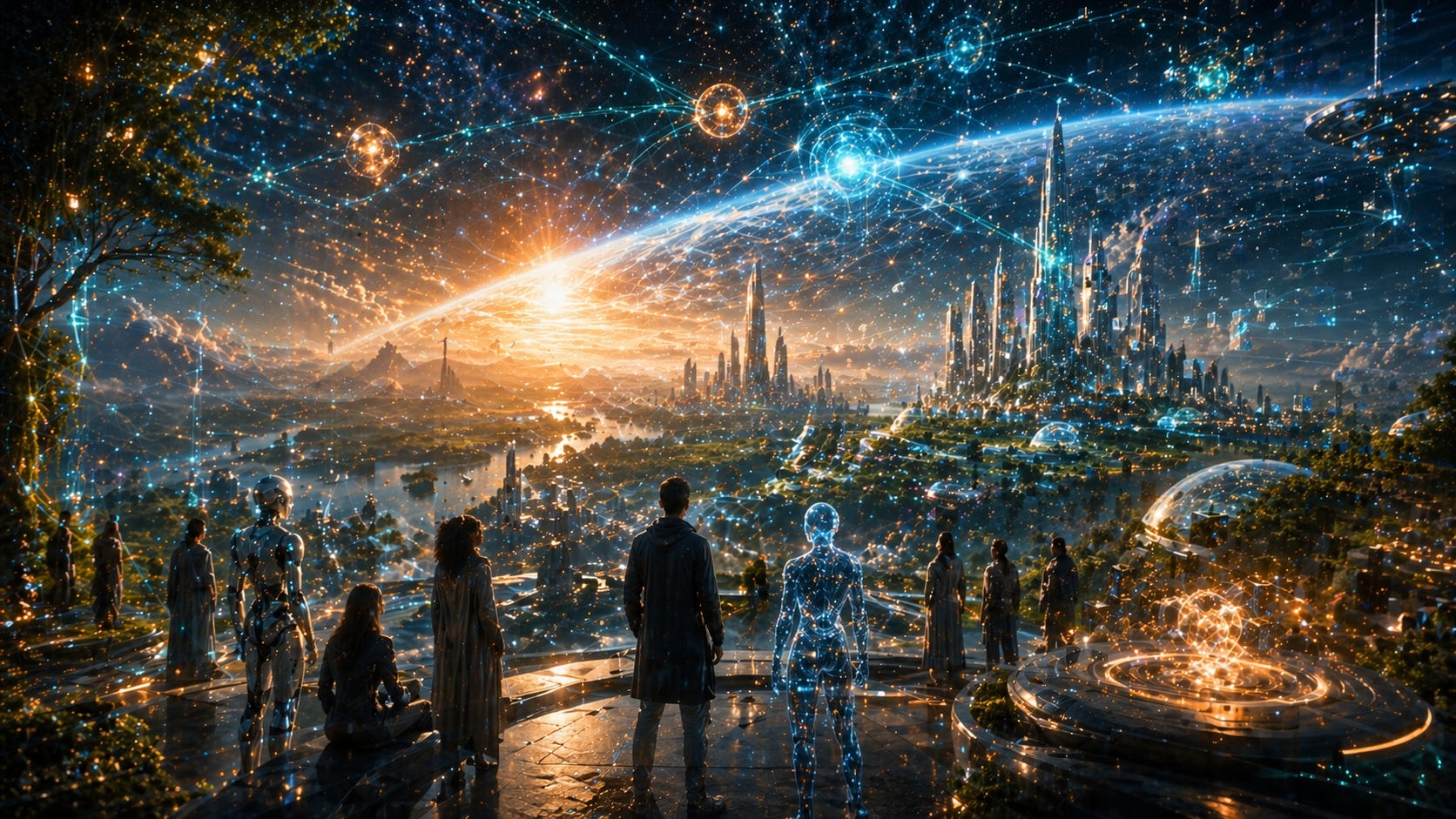
The Up-Wing 3.0 position is clear: reality is becoming programmable at the cultural layer, and civilisation needs people awake enough to build with responsibility.
The old ideological camps are badly equipped for this. One side sees technology as a machine of control. Another sees it as a market gadget. Both miss the bigger picture.
AI, quantum information, simulation theory and techno-futurism are now part of the same civilisational conversation. We’re learning that reality may be informational at the root, and we’re building tools that operate through information at a planetary scale.
That combination demands courage.
It demands sovereignty.
It demands builders who can think spiritually without losing rigour, and think technically without losing the soul.
Terra 2.0 is my name for that work: a future where human and machine intelligence grow together in service of life, freedom, abundance and awakening.
The universe may be stranger than matter.
Good.
So are we.

Continue the Render
If this reflection resonates, I’d love to hear how it lands with you.
Are we living in a simulation, a naturally computational universe, or something stranger than either model can hold?
Share your thoughts, challenge the ideas, or extend the signal. This conversation is still rendering.
Explore more at MyGeekSpace | Living the Future, where I map Terra 2.0, AI, sovereignty, future civilisation, and the evolution of Homo techno.
→ If you value independent, future-focused writing, consider subscribing to MyGeekSpace, free or paid. You can also support the work with a one-time contribution below.
→ For deeper notes, early access, and behind-the-scenes reflections, you can also join me on Patreon.
→ Follow me on 𝕏 @frankdasilva for real-time signals on AI, culture, reality, and the future we’re building.
Futūrum Vīvere.
