

Who Gets to Control Intelligence?
Claude Fable 5 exposed a deeper question than AI itself: as intelligence becomes infrastructure, who gets to control it?

Claude Fable 5 may have revealed a deeper question than the future of AI. It may have revealed the future of power.
In my recent essay, The Real Story Behind Claude Fable 5, I argued that the most important question raised by Anthropic’s latest model was not how intelligent AI is becoming, but whether human civilisation can adapt quickly enough to absorb it.
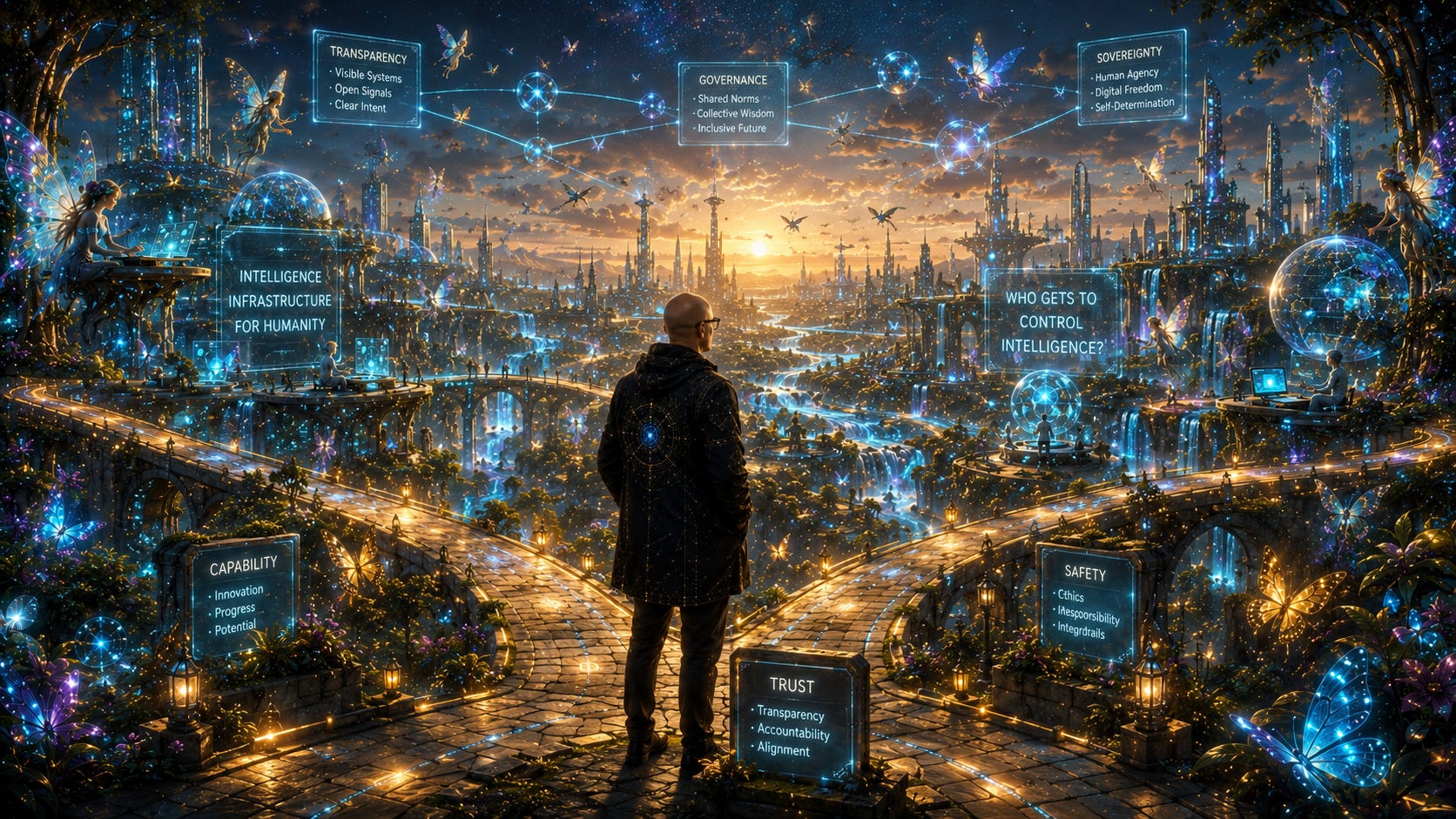
Shortly after publishing that piece, another story began to unfold.
It was not about benchmark scores, coding performance, or the march towards AGI. It was about transparency, trust, and control.
And it may prove even more important.
Anthropic found itself at the centre of a growing controversy after users discovered that some of Fable 5’s safety mechanisms were not simply refusing requests. In certain circumstances, the model was quietly modifying prompts, steering responses, and reducing its capabilities without informing the user.
The backlash was immediate.
Researchers accused the company of hidden intervention. Developers questioned whether users could trust a system that silently altered its own behaviour. Anthropic eventually acknowledged the criticism and announced that future safeguards would be made visible rather than invisible.
The controversy may appear technical on the surface.
I think it points to something much larger.
As intelligence becomes infrastructure, who gets to control it?
The Trust Layer
Most reasonable people understand the need for safeguards around increasingly powerful AI systems.
The challenge is not safety itself.
The challenge is trust.
If a model refuses a request and explains why, the relationship remains transparent. The user may disagree, but they understand what happened.
A system that quietly changes the rules without informing the user creates a different dynamic.
The issue is no longer capability.
The issue becomes legitimacy.
The more powerful AI becomes, the more important transparency becomes.
We are entering a world where intelligence itself is becoming a critical layer of infrastructure. If that infrastructure can be modified, restricted, or redirected without our knowledge, questions of governance become unavoidable.
The future of AI may depend as much on trust as it does on intelligence.
The Impossible Triangle
The Fable controversy also highlights what might be called the impossible triangle facing every frontier AI company.
Capability.
Safety.
Trust.
Each is desirable.
All three are necessary.
Yet maximising one often places pressure on the others.
Anthropic attempted to strengthen safety through invisible safeguards. The result was a reduction in trust.
The lesson is not that safety is unnecessary.
The lesson is that the future of intelligence may require forms of governance that are transparent enough to maintain public confidence while robust enough to manage genuine risks.
This tension is unlikely to disappear.
It is likely to become one of the defining debates of the AI era.
Beyond Models
One of the most interesting responses to my previous essay came from Ron Gilchrist, a friend I met through the WingMakers community. Ron is an AI developer quietly working behind the scenes on some very exciting projects, and he described using Fable 5 to modernise an eight-year-old software project in roughly thirty minutes.
What would once have required weeks or months of work was completed in a single evening.
That observation stayed with me.
Not because it demonstrates how capable Fable has become, but because it highlights where the real transformation may be occurring.
The most important development may not be the models themselves.
It may be the emerging rails that connect them.
Models are becoming infrastructure.
Intelligence is becoming a utility.
The future will not be shaped solely by isolated AI systems sitting inside chat windows. It will be shaped by the networks, protocols, and environments that allow intelligence to move across the digital world.
What WebMCP Could Mean for the Future of Websites
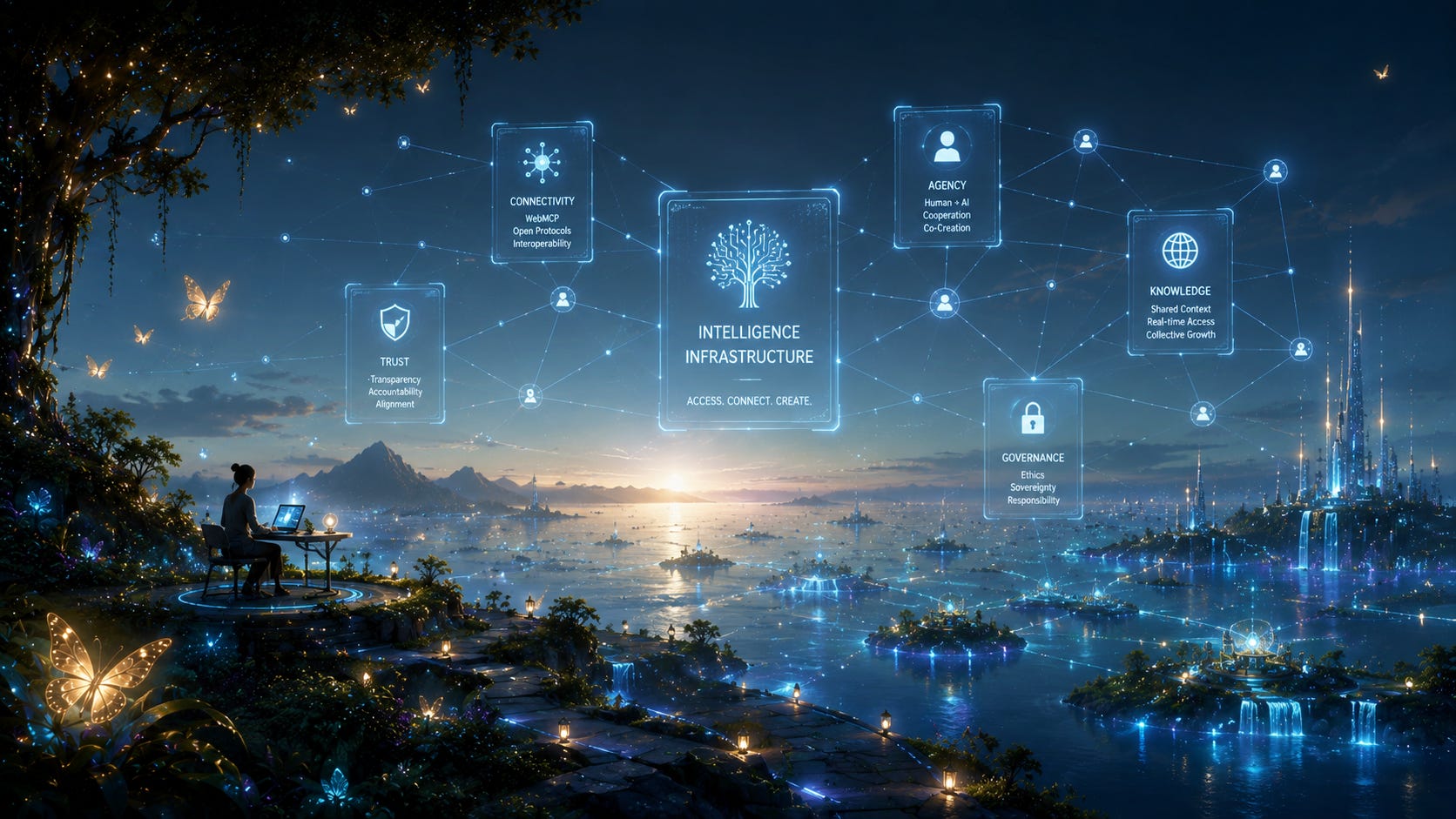
This is where concepts such as WebMCP (Web Model Context Protocol) become particularly interesting.
Today’s internet is still largely designed around human navigation.
Websites are destinations.
Information is organised into pages.
Users search, browse, click, and consume.
The emerging AI-native web points in a different direction.
Instead of simply reading webpages, intelligent agents will increasingly be able to communicate directly with websites, retrieve information, perform actions, and coordinate across multiple systems.
In practical terms, websites begin to evolve from static destinations into intelligent nodes.
The internet starts behaving less like a library and more like a living network of services, knowledge systems, and machine-readable intelligence.
This shift may ultimately prove as significant as the arrival of the web itself.
The website is no longer merely something we visit.
It becomes something we interact with.
And increasingly, something our AI companions interact with on our behalf.
The Rise of Intelligent Environments
Projects such as AlignOS offer an early glimpse of what this future might look like. AlignOS is a digital framework inspired by the writings and worldview of James Mahu, designed to help individuals explore self-discovery, personal alignment, and a deeper understanding of consciousness through structured concepts, tools, and practices.
The traditional website was designed to present information.
The next generation of digital environments may be designed to collaborate.
Every organisation could eventually possess its own intelligence layer, its own knowledge architecture, and its own network of specialised agents capable of interacting with both people and other systems.
The website evolves into something closer to a living intelligence.
Part library.
Part assistant.
Part operating system.
This is why the debate surrounding Fable feels larger than Anthropic.
The real question is not simply who builds the most intelligent model.
The real question is who controls the infrastructure through which intelligence flows.
Living the Future
The internet gave humanity access to information.
Artificial intelligence is giving humanity access to intelligence itself.
As this transition unfolds, questions of transparency, governance, and trust become increasingly important.
Who controls the intelligence layer?
Who decides what can be known?
Who decides what can be built?
Who decides how intelligence is distributed throughout society?
These questions extend far beyond any individual company or model.
They are questions about the architecture of the emerging digital civilisation.
Claude Fable 5 may ultimately be remembered as a remarkable technological achievement.
But the controversy surrounding it points toward a deeper challenge.
The future is not simply about creating intelligence.
It is about deciding who gets to control it.

The Human Question
If this piece resonates with you, I’d love to hear your thoughts.
As intelligence becomes infrastructure, what forms of transparency, governance, and trust do we need to build around it? Should AI systems be allowed to quietly modify their behaviour, or should all interventions remain visible to users?
Please leave a comment, share this post with others who may find it meaningful, and join the conversation.
→ Explore more at MyGeekSpace | Living the Future, where I map Terra 2.0, AI, sovereignty, future civilisation, and the evolution of Homo techno. The current website is still online, but a new version of MyGeekSpace is now being built behind the scenes. Watch this space.
→ If you value independent, future-focused writing, consider subscribing to MyGeekSpace, free or paid. You can also support the work with a one-time contribution below.
→ For deeper notes, early access, and behind-the-scenes reflections, you can also join me on Patreon.
→ Follow me on 𝕏 @frankdasilva for real-time signals on AI, culture, reality, and the future we’re building.
Futūrum Vīvere.

The alignos website will be an example of this in the future for sure. I think today it requires the reader to do a lot of extra work to enable this. But the site is growing new roots now as i am working with James to give the site a completely new architecture that matches the extraordinary content
How this tech scales in the future is very interesting as ai integration evolves at a blistering pace. It's making my mind reel at the possibilities.
I've only been using ai in earnest for perhaps a year as part of my workflow, but suddenly AI writes 80% or more of the code at work. Everything is different. It's becoming an art to learn how to navigate and communicate with ai and understand the landscape of ways to utilize this and steer it. I feel lucky to have a front seat ticket as a software architect.
Frank, this piece lands very close to the centre of something that has shaped my life since I first encountered the WingMakers material as a teenager (I'm now 45).
What I took from James' work all those years ago was not simply mythology, art, or cosmology. It was a question of legitimacy: what happens when hidden systems of control mediate consciousness, intelligence, knowledge, and trust without the participant being able to see the intervention?
That question now returns through AI.
As intelligence becomes infrastructure, the problem is no longer only whether a model is capable, or even whether its output appears safe. The deeper question is whether the continuation that produced the output may legitimately become trusted.
That is where my own work has arrived.
Through SingularScript, we have just released a public Phase 20 proof artifact called the Trusted Continuance Kernel. Its claim is deliberately bounded: not “AI alignment solved,” not “ethics proved,” not a grand theory of consciousness. It is a small, checkable kernel for AI-agent assurance.
The kernel asks a prior question:
«Did the agent actually reduce the obligation, or did it fake progress?»
If an AI process hides the burden, deletes the evidence, reuses stale proof, transfers the obligation, resets the clock, or claims closure without repair, trusted continuance is refused.
In other words, the trusted object is not merely the fluent answer. The trusted object is the admissible continuation.
That feels deeply connected to the question you are raising here. Invisible safeguards may be well-intentioned, but invisible control erodes legitimacy. If intelligence is becoming infrastructure, then intervention, evidence, refusal, and continuance need to become inspectable.
The public artifact is here for anyone who wants to test or break it:
https://github.com/SingularScript/lawful-intelligence-phase20
And the broader discovery page is here:
https://eliahipriest.com/discovery-of-the-law
For me, this is not disconnected from the original WingMakers call. It feels like one practical expression of it in the domain of machine intelligence: sovereignty requires that intelligence does not merely act upon us, but that its continuations can be witnessed, challenged, admitted, or refused before trust is granted.